Pages

Showing posts with label world news. Show all posts

Tuesday, October 12, 2010

Chilean president: Looking forward to imminent mine rescue

Copiapo, Chile (CNN) -- Chilean President Sebastian Pinera says he is looking forward to the imminent rescue of the 33 miners trapped for more than two months nearly half a mile below ground.
Officials have said rescue crews willbegin Wednesday -- and perhaps even earlier -- pulling the men to safety.

"Ihope that by tomorrow [Tuesday] or Wednesday, the miners will not only be able to see sunlight, but embrace their wives and girlfriends, parents, mothers and children," Pinera told CNN en Espanol on Monday.

Planning to watch the rescue? Share your reaction

Pinera, who is expected at the mine site for the rescue, spoke in Quito, Ecuador.

"We have been with the miners since the accident and will remain with them once they are rescued," he said.

The president added the miners' reintegration into society will likely be difficult as they must build new lives and will face the added pressures that come from global media attention.

Chilean Mining Minister Laurence Golborne told reporters Monday outside the mine that workers are hoping to initiate the rescue beginning late Tuesday night or early Wednesday.

Though it may come even sooner, Golborne said, "We're going to take all the time necessary to assure that the plans are adequate."

That decision was made after the rescue capsule, called Phoenix 1, was lowered to 610 meters (about 2,000 feet), 12 meters short of where the men are trapped, he said.

"It fit very well," he said. "Not even dust fell inside."

Asked why the capsule was not lowered all the way into the mine, Golborne joked, "We could not risk that somebody might jump in."

The extraction cannot begin immediately because the concrete base built for the winch system must first harden, he said.

On Monday afternoon, Alejandro Pino, regional manager of the Chilean Safety Association, presented to reporters the gear that the miners will use once their rescue begins.

Each miner will receive green coveralls embroidered with their names, as well as fresh pairs of socks and underwear. The outfits are made of material designed to resist moisture, Pino said.
He urged reporters to allow the miners, as they come up, to spend time alone with their families.
"Let them have long embraces," he said.

In addition, each miner will also be given a blanket embroidered with their names. "They're going to be able to keep it for their homes," he said.

During their conversation Monday, the miners told Pino, "We're anxious, but tranquil," he said.

The miners' personal trainer, Jean Romagnoli, said the miners will wear a special belt that will monitor their vital signs during their ascent, which will be monitored from a computer on the surface.

"I don't need to see [the miner in the rescue capsule] to know exactly what is going on with him," he said.

All of the miners appear to be in good physical and emotional shape.

"We are extraordinarily content," said Chilean Health Minister Jaime Manalich.

Earlier Monday, workers cheering "Viva Chile" completed the installation of steel tubing to reinforce the path that rescuers plan to use to hoist the trapped miners to the surface.

About 56 meters of sheet metal has been put in place to line the tunnel, according to Andre Sougarret, the rescue leader. Plans for a longer tube were aborted after they were deemed not necessary, he said.
Officials have said that the most technically adept miners will be the first to ascend the rescue shaft so that they can help with their own rescues should any problems arise. They will be followed by miners who have health concerns, such as diabetes or heart conditions. The miners judged to be emotionally strongest will go last.

"They continue to have an admirable attitude," he said.

Beginning six hours before the rescue starts, the miners will be switched to a diet of liquids, vitamins and minerals ahead of their trip to the surface. Each trip is expected to take about 15 minutes.

The change in diet is one way that officials are trying to mitigate some of the challenges associated with the rescue. These include concern about the miners feeling lonely, dizzy or panicked.

Authorities plan first to lower a doctor and a rescuer into the chamber, Manalich said earlier.

Once the men have been extracted, they will undergo about two hours of health checks at a field hospital set up at the mine. They will then be flown by helicopter to a hospital in the town of Copiapo -- approximately a 15-minute flight.

Miners who are healthy enough will be allowed to visit briefly with family members in a reunion area before being taken to the hospital.

Health officials have increased the miners' physical activity in recent days to gauge how they can handle the stress of being removed.

The overall response has been good, though some miners have exhibited anxiety or have had minor cardiac issues, Manalich has said.

The miners have been in contact with the outside world through a small bore hole that sends them food, water and other supplies and necessities.


For More : http://edition.cnn.com/2010/WORLD/americas/10/12/chile.trapped.miners/index.html

Wednesday, September 22, 2010

Times changing in China -- for the good, says ministry


China ― China's notorious one-child policy may be coming to an end. Why? The male-female ratio in China is said to be 119 males to 100 females. The other problem is the aging population will lack caregivers. With one married couple left to take care of four aging parents, the pressure is great.


Jonathan Brooks, President of Bibles for China--a ministry of Voice of China and Asia, says this is old news. "The people of China seem kind of surprised that we would be asking about it because to them it was old news. What we see as a new policy in China, that you can have more than one child. People generally -- especially in Christian circles -- don't realize that this is really old news, that the policy has changed."

While some news reports suggest the one-child policy has only been changed in certain provinces, Brooks is seeing change in China. He says the church is just one example. "We're seeing a great awakening in China, and what we're hearing is there is a real fervency in the believers in China. And this isn't just in the underground church, but the above-ground church."

While the registered churches aren't free as they are in the United States or Canada, Brooks says they are free to preach the Gospel. He says many are turning to Christ because of it, and Bibles are in high demand.

"What we're hearing from the United Bible Society is that the Bible is the unofficial best-selling book in China. It's available in large population centers," says Brooks.

However, he says that's a problem. "70-percent of China's new believers that are coming to Christ are out in the rural areas. They don't have access to the larger population centers where Bibles can be purchased in the registered churches." Even if they could get to these areas, they wouldn't be able to afford to purchase them. Each Bible costs a significant percentage of their income.

Bibles for China was born out of this need. "For $5 we can purchase a legally-printed Bible. We can transport it. We'll even have the assistance of the government officials to help us transport these Bibles and take us right into their registered churches."

Brooks says your financial support touches lives. "For every Bible we pass out, our past surveys have shown us that that Bible will be read by five people. And out of those five people, at least three people will come to Christ."

While you can't just step off the plane and go distribute Bibles, Brooks says if you follow the rules, you can have uninterrupted ministry.

Top Economic Adviser To Leave White House

President Barack Obama's top economic adviser, Lawrence Summers, plans to leave the White House at the end of the year, a move that comes as the administration struggles to show an anxious public it's making progress on the economy.

While administration officials Tuesday quickly sought to paint the announcement as an expected development, Summers' departure shakes up an economic team that has been under fire for its handling of the recovery. It's also a team already in transition following the recent departures of other high-profile Obama advisers.

In a statement, the president said he is grateful for Summers' service during a time of "great peril for our country."

"While we have much work ahead to repair the damage done by the recession, we are on a better path thanks in no small measure to Larry's wise counsel," Obama said.

Summers will return to Harvard University, a move a senior administration official said was always part of Summers' long-standing plans. The official said the president asked Summers last fall to stay through 2010 in order to see through the passage of financial regulatory legislation and the continued implementation of the economic stimulus package. The official spoke on the condition of anonymity in order to discuss internal White House matters.

Summers is the third high-level member of Obama's economic team to leave in recent months, following the departure of budget director Peter Orszag and Christina Romer, head of the Council of Economic Advisers, both of whom left this summer. Treasury Secretary Timothy Geithner would be the only one of Obama's top-tier economic advisers to remain with the administration should be stay through the end of the year.

There was speculation that Obama might turn to a corporate executive to replace Summers as a way to deflect criticism that his administration is antibusiness. Also, the White House is acutely aware that there are no women in top economic posts following Romer's departure, nor do the current team of advisers have significant private-sector experience.

Summers' departure was first reported Tuesday by Bloomberg News.

With unemployment hovering near double-digits and the public growing increasingly worried about the slow pace of the recovery, Democrats fear the economy could lead to sweeping losses for the party in the midterm elections.

Last month the top House Republican, Rep. John Boehner of Ohio, called on Obama to fire Summers, Geithner and other members of the economic team.

"Never before has the need for a fresh start in Washington been more pressing," Boehner said during a speech in Cleveland.

At the time, the White House dismissed Boehner's calls as politically motivated. But during a town hall Monday, Obama wouldn't rule out changes on the economic team, saying only that he hadn't yet made any determinations on personnel matters.

"This is tough, the work that they do," Obama said. "They've been at it for two years, and they're going to have a whole range of decisions about family that will factor into this as well."

Republicans will interpret Summers' departure as a sign that Obama is rethinking his economic policy. But even some Democrats might quietly rejoice.

Summers, often seen with a Diet Coke in his hand, has a reputation as a brilliant, if occasionally smug, economist. During the debate over overhauling the nation's financial regulations, liberals bristled at Summers' rejection of proposals to place limits on the size of banks. They held him partly responsible for the deregulation of banks that occurred in 1999 while he was treasury secretary under President Bill Clinton.

When he returns to Harvard, he will be going back to his roots. At age 28 he became one of the youngest professors to receive tenure at Harvard. After leaving the Clinton Cabinet in 2001, he returned to Harvard as its new president, where he had a tense relationship with the university faculty. It erupted when he argued that gender differences explained why fewer women pursued math and science careers. He resigned in 2006.

In a statement, Summers said he will miss working with the president and the economic team but looks forward to returning to Harvard to teach and write about the economic fundamentals of job creation.

Father: Army Ignored Complaints Of Afghan Slayings

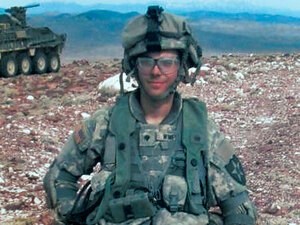
Army Spc. Adam Winfield complained in Facebook messages to his father that he was being hounded by his platoon leader, Staff Sgt. Calvin Gibbs.

Gibbs was angry when Winfield failed to lock the hatch of his armored vehicle, so the sergeant gave him extra duty. Fed up, Winfield tapped out a message to his father, Chris, on a January day, complaining that his mistakes were minor compared to what Gibbs had done.

Chris Winfield says his son called Gibbs the "golden child of the platoon."

"He said the golden child can do no wrong. He can commit murder ... and get away with it and everybody seems fine with it."

The Army has now charged Gibbs with three murders. The charging documents allege the first murder occurred shortly before Winfield sent that message to his father. The Army says Gibbs tossed a grenade at an Afghan civilian and then ordered his soldiers to open fire, killing the man.

Gibbs' lawyer, Phillip Stackhouse, says his client did nothing wrong, and that all the killings took place during combat and were justified.

Chris Winfield didn't hear from his son again until February. This time, says the father, his son's messages were more desperate.

"He was kind of torn, 'Do I do the right thing? Do I put my life on the line? Do I say something to somebody? What do I do?'" says Chris Winfield.

"I said, 'Is there anyone you can go to?' He said, 'No.' He said, 'Gibbs is watching my every move. He's already threatened to me that if I do anything he's going to do something to me.'"

Besides the murder charges against Gibbs, the Army also has charged him with threatening Winfield and urging Winfield to lie to investigators about drug use in the platoon.


After those messages from his son, Chris Winfield took it upon himself to get someone in the Army to listen. He left messages with an Army hotline. He spoke with a sergeant at Fort Lewis, Wash., where his son's unit -– the Stryker brigade — is based. That sergeant referred him to Army investigators, whom he called and left a message.

He then spoke with another sergeant at an incident command center at Fort Lewis who suggested his son report the incident after he gets home.

Chris Winfield recalls what the sergeant said: "Then he can turn the guy in safely and not worry about any repercussions."

"And I said, 'You've to go be kidding me.'"

Eric Montalvo, Winfield's lawyer and a retired Marine officer, says the system failed.

"All service members have a basic obligation that if they are in receipt of information about a crime, they're required to do something about it," he said.

Army officials say they are looking into why no one followed up on Chris Winfield's calls. It was after those calls, according to Army documents, that two more killings of Afghan civilians were committed by Gibbs and his soldiers: one in February; another in May.

Among those charged in the third alleged murder: Winfield, the same soldier who wrote his dad and alerted him to what was going on. The Army says Winfield shot at an unarmed Afghan man after Gibbs tossed a grenade.

Winfield's lawyer says his client was ordered to shoot by Gibbs, but aimed high.

"We were floored. I was shocked," says Chris Winfield. "If they had listened to me for one thing, my son would have never been arrested and two, there would have been two Afghans still alive," he says.

The Army finally did listen to Winfield, only after his son was charged. Army investigators went to his home in Florida to get a statement, the Facebook messages from his son and his phone log of calls to the Army.

Cyberwar Risk Poses Specter Of Cyberwar Crimes

Air traffic control systems are part of the national infrastructure that may someday come under attack, experts say. Here, flights bound for Baltimore/Washington International Thurgood Marshall Airport are highlighted on a monitor.
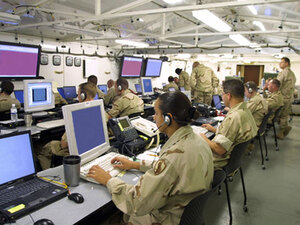
Soldiers monitor computer screens inside the U.S. Central Command's mobile headquarters, in this U.S. military photo from 2002. A major concern regarding cyber warfare is the difficulty in distinguishing military targets from civilian targets.

Soldiers monitor computer screens inside the U.S. Central Command's mobile headquarters, in this U.S. military photo from 2002. A major concern regarding cyber warfare is the difficulty in distinguishing military targets from civilian targets.
It may come as a surprise to some war victims, but there actually is a body of international law that establishes when and how nations can legally engage in armed conflict.

Various treaties — the United Nations Charter, and the Hague and Geneva conventions — distinguish between victims and aggressors, and put forward combat guidelines that, when honored, provide some protection to civilians. Professional militaries train with the rules of war in mind, recognizing that abiding by them works to their benefit as much as to the enemy's.

It is no surprise, then, that many legal experts, diplomats and military commanders around the world are now debating how to extend the law of war to cyberspace. The emergence of electronic and cyberwar-fighting capabilities is the most important military development in decades, but it is not yet clear how existing treaties and conventions might apply in this new domain of conflict.

We don't know when or if a cyberattack rises to the level of an 'armed attack.'
Uncertainty about the legal and ethical limits of state behavior in cyberspace could have disastrous consequences.

"If nations don't know what the rules are, all sorts of accidental problems might arise," says Harvard law professor Jack Goldsmith. "One nation might do something that another nation takes to be an act of war, even when the first nation did not intend it to be an act of war."

Under the U.N. Charter, states have the right to go to war if they come under an "armed attack" from another state. But there is no consensus yet on what that right means in the event of an attack on a country's computer networks.

One important consideration is whether the attack is the work of a lone hacker, a criminal group or a government. The law of war applies primarily to conflict between states, so truly rogue actions would not normally be covered.

The purpose of the activity is also relevant. Michael Hayden, having directed both the National Security Agency and the CIA, would not include an effort by one country to break into another country's computer system to steal information or plans.

Cyberwar Or Simply Espionage?

"We don't call that an attack," Hayden said at a recent conference on hacking. "We don't call that cyberwar. That's exploitation. That's espionage. States do that all the time."

Cyberwar, Hayden and others argue, involves a deliberate attempt to disable or destroy another country's computer networks. But how much damage must be done before a cyber operation could be considered an act of war under the U.N. Charter — and thus justify the use of force in response?

"We don't know when or if a cyberattack rises to the level of an 'armed attack,' " says Daniel Ryan, who teaches cyber law and the law of war at the U.S. military's National Defense University.

International law is also somewhat unclear when it comes to how states could use cyberweapons in wartime. The Hague and Geneva conventions require militaries to minimize the damage to civilians in wartime. So in a cyber conflict, military targets would presumably have to be distinguished from civilian targets, with civilian computer networks off limits.

"A direct attack on a civilian infrastructure that caused damage, even loss of life of civilians, would, I think, be a war crime," Ryan says.

The civilian computer infrastructure would include the networks that control an air traffic control system or a water supply, for example. But distinguishing civilian and military cybertargets is not necessarily so simple.

Private Networks

"Computers don't always have signs over them that say, 'I'm a military target' [or] 'I'm a civilian target,' " says Harvard's Goldsmith. "Also, the two things are intermixed. Ninety to 95 percent of U.S. military and intelligence communications travel over private networks."

One danger is that an attacking military may set out to hit a military target but then hurt civilians in the process. This could happen if the attack is disproportionate to the military objective.

The law of war requires "proportionality." You can't level a city to destroy a single military unit located there. In the cyberworld, this rule means you couldn't plan a massive computer attack, even on a military network, without regard for the civilian computer networks that would be affected by that attack.

But with computer networks so highly interlinked, it will be harder to adhere to the proportionality rule in a cyber conflict than in a conventional war.

"The U.S. government, when they're dropping a bomb, they have all sorts of computer algorithms and studies that they use to show exactly what the consequences are going to be from dropping this bomb from this angle on this building," Goldsmith says. "Those consequential analyses are much harder in cyberspace, and so it's hard to apply the proportionality test."

Given all the indirect effects that might flow from a cyberattack, cyberwar planners could easily be confounded by the legal considerations.

Looking For The 'Right Answer'

"Since we can't predict what the unintended consequences of the use of cyber might be, that would say, you can't attack at all in cyberspace," Ryan says. "That can't possibly be the right answer."

To Ryan, the "right answer" is that commanders should have to consider those effects of a cyberattack they are able to consider, but not those consequences that can't be anticipated.

Former CIA Director Hayden, a retired Air Force general, suggests using common sense. One example of an attack that should be illegal, he says, would be the insertion of damaging software into an electrical grid.
"Overall, finance is so dependent upon investor confidence that cyberpenetration of any electrical grid, for whatever transient advantage it might create for the aggressor state, is so harmful to the international financial system that we should just all agree: These are like chemical weapons; we're just not going to use them," Hayden said in July.

Yet another troublesome issue is how the rules of war could be enforced in cyberspace. Skeptics point out that even if governments could agree on what is illegal, it wouldn't necessarily mean they would honor those agreements.

"It is a near certainty that the United States will scrupulously obey whatever is written down, and it is almost as certain that no one else will," says Stewart Baker, a former NSA general counsel and an assistant secretary of homeland security under President George W. Bush.

'No One Is Going To Get Caught'

If anything, it would be harder to enforce the law of war in the cyberworld than in other domains of warfighting. The amount of anonymity in cyberspace means that a devastating attack might leave no "signature" or trace of its origin.

"Since we know that that's going to happen all the time," Baker says, "and no one is going to get caught, to say that [a cyberattack] is a violation of the law of war, is simply to make the law of war irrelevant."

But whether war crimes are prosecuted or not, military commanders like to know the rules under which they are supposed to fight. "There is a great deal of discussion going on right now about this," says Daniel Ryan, whose students at the National Defense University include senior U.S. military and government officials.

Discussion of the legal and ethical issues around cyberwar is also a popular and controversial subject at the United Nations; the upcoming session of the U.N. General Assembly is likely to feature renewed debate over the issue.

Sunday, September 19, 2010

Despite tensions, U.S. governors flock to China


Beijing, China (CNN) -- In the midst of tense U.S. Congressional hearings on China's currency last week, four U.S. state governors -- including California Governor Arnold Schwarzenegger and Minnesota Governor Tim Pawlenty -- were in China hoping to cement business relations.

More U.S. governors are looking to China for an international solution to local economic problems and unemployment, despite heightened trade and currency tensions between Beijing and Washington.

"[China] represents massive economic opportunity and massive economic benefit...in a way that's going to translate in job growth for our citizens," Minnesota Governor Pawlenty said in Beijing last week. "It is absolutely amplified by the downturn in the recession and this heightened thirst to do anything and everything we can to create jobs."

Even California, considered the 8th largest economy in the world, is looking across the Pacific for a long-term economic boost.

"California jobs, business vitality, and our cultural identity all are deeply tied to the Asia-Pacific region," said Schwarzenegger in a statement during his trip to China last week.

Besides Pawlenty and Schwarzenegger, Governor Chris Gregoire of Washington was in Beijing last week meeting with high-level officials. Governor Sonny Perdue of Georgia was also visiting China, its second-largest trading partner.

The steady stream of U.S. state leaders to China shows that despite tense trade issues on the national level, many governors are bullish on the Middle Kingdom's economic potential, hoping to tap into its massive consumer population.

"People can now see you [can] come to China and still grow your business in America," said Paul Swenson, director of The China Hand Consulting Company, which advises states on trade and investment in China. "They are not mutually exclusive."

In August, the Southern Governors' Association featured former Chinese Ambassador to the U.S. Zhou Wenzhong, seven U.S. governors, and CEOs of major Chinese companies in a seminar focused on strengthening trade and business relations between China and U.S. southern states.

"[This] is where a big part of the global economic growth is going to be in terms of consumer demand," said Pawlenty. "Anybody who thinks about it for very long is going to quickly conclude that you have to be in China."

In their first trip to China, the Minnesota Corn Growers Association joined Pawlenty's trade delegation hoping to dovetail the growing demand of corn in China -- 1.3 million tons of U.S. corn were exported to China last year, the most in 14 years. Analysts say China's increased demand for corn could represent a longer term structural shift as agribusinesses consolidate in China and rely more on raising livestock.

"You're seeing all of this increasing activity and all of this increasing attention because [small- and medium-sized business owners], well, everyone understands the incredible potential for exports and economic opportunity that comes with being able to sell to China," Pawlenty said.

In addition, U.S. businesses are trying to insert themselves into critical but less developed parts of Chinese industry. The cycle that feeds the U.S. trade deficit isexports of American-made machinery and raw materials to China and higher-value finished products in return. U.S. exporters hope to reverse that trend by establishing new markets in China, such as logistics and food safety know-how.

"These [states and companies] might be selling some supplements that improve the health of the Chinese dairy cows, or disinfectant that cows walk through so that they don't bring infections into the dairy barns," said Swenson of The China Hand Consulting Company.

"We're participating in the food chain but not producing the food itself. We are manufacturing what supplies the safety," Swenson said. "That's becoming a big market here and it has created a lot of unforeseen benefits...and jobs."

Moreover, the Chinese central government appears to be softening its stand on imports. Earlier this month, the Ministry of Commerce convened the China Import Forum, focused on "an opening market and global trade." Hundreds of major business leaders attended what some called a "crash course" in China import policy and commercial engagement.

Attendees, including Swenson, noted a genuine tone in the Ministry of Commerce's approach.

"There was a brainstorm on how China can grow their imports," Swenson said. "And it seemed to be very real...that balancing trade was something important to them."

China's Ministry of Commerce is also sending several major trade delegations to the United States this fall, in attempt to increase U.S. exports to China.

Ministry Spokesman Yao Jian announced one delegation comprising almost 50 business leaders departed Beijing for the U.S. on Tuesday, to "seek trade and investment opportunities in such areas as energy and technology."

Two more delegations will fly to the U.S. by the end of this year, the spokesman told state-run media.

The delegations will be visiting during a tense time in US-China trade and currency relations, but they can expect a warm welcome from U.S. governors attempting to lure Chinese business into their home states with hopes that foreign direct investment will energize and invigorate local economies.

In Shanghai last week, Schwarzenegger signed a memorandum with the Chinese Ministry of Railways and the Bay Area Council for investing in California's future rail network.

Unable to specify the exact negotiations, Minnesota Gov. Pawlenty also indicated that major negotiations were underway to bring a major Chinese company into the land of 10,000 lakes.

"The capital investment that would bring, the jobs that would bring, the other indirect economic activity...well, I think that would be a terrific success," Pawlenty said.


For More :  http://edition.cnn.com/2010/BUSINESS/09/20/us.china.governors.trade/index.html?hpt=C1

12 killed, 30 hurt in India train collision

New Delhi, India -- A freight train collided head-on Monday with a passenger train waiting at a station in central India, officials said.

Twelve people were killed and wounded 30 others in the crash in the state of Madhya Pradesh, said railway spokesman Anil Saxena.

Among those wounded, 10 were seriously hurt, Saxena said.

Authorities could not immediately say what caused the crash.

India's massive rail network used by hundreds of thousands of passengers daily has a poor safety record.

Official figures show 100 train accidents occurred in the country in the 2009-10 fiscal year and 115 in 2008-09.

Hey, America: I'm a Muslim, Let's Talk

Demonstrators clash near Ground Zero.

Mona Eltahawy

I have developed an overwhelming urge to tell everyone I meet I'm a Muslim.

As a Muslim woman who doesn't wear a headscarf, I'm often mistaken for a Latina and other ethnicities that my features match. But as anti-Muslim sentiment has risen across the United States, so has my urge to say, "Hey America, I'm a Muslim. Let's talk."

That urge took me to the sidewalk in front of Park51, the proposed community center and mosque near Ground Zero, over Labor Day weekend. I spent four days with a small but dedicated group of sidewalk activists who for more than three weeks have stood in front of Park51 with signs reading "Peace Tolerance Love" to support its right to build. 

The volunteer sidewalk activists are a mix of non-Muslims and Muslims, newly minted activists in their 20s, and veteran activists of their parents' generation.

We were not there to defend or speak for any of the spiritual or financial backers of Park51. We were there to defend Park51's constitutional right to build. For me, opposition to Park51 was part of that larger pattern of anti-Muslim sentiment that had expressed opposition to several other mosque projects around the country. It was much bigger than Park51.

The easiest people to deal with, for me, were what I called the "hit and runs"—passersby who thanked us or those who would hurl insults as they moved on.

Those four days in front of Park51 taught me a lot. First, I learned to resist labeling as a "bigot" anyone who opposed its building. Some of those against Park51 were indeed bigots, but as my sidewalk activist friends taught me, when you call them bigots it makes them defensive and it ends up shifting the focus from the issue at hand—the necessary discussion about Park51's right to build—to the hurt feelings of the people you just called bigots.

And that necessary discussion can bear fruit. Two women who had walked over to Park51 from a nearby protest against the center had some questions. One wanted to know about jihad. I said I condemned all acts of violence committed in the name of any religion, including my own. After some back and forth, Meryl said we both should launch a jihad against violence in the name of any religion and asked if she could hug me.

"Why aren't there millions of Muslims like you?" she asked.

"There are," I answered.

Mary wanted to know how, as a woman, I could remain a Muslim when Muslim women were treated so badly.

I told her I would be lying if I said that women in Muslim-majority countries enjoyed equal rights but also told her I belonged to a movement called Musawah, which means equality and which aims for equality and justice in the Muslim family by working to remove misogynistic and male-dominated interpretations of Islam.

Again, after a back-and-forth discussion, Mary hugged me too.

Later, another woman asked: "Can't you see that you're hurting people's feelings by building so close to Ground Zero? Think of the victims' families."

"Can you see when you ask me a question like that you're assuming that I had something to do with the attacks on 9/11?" I answered. "Those men were Muslim but it was 19 men. None of us here had anything to do with it."

"But would it be so hard to move it somewhere else?"

"That's a really slippery slope," I told her. "There are mosques across the country being opposed. Where do you draw the line? Once you make Park51 move, anyone can say, 'Oh I don't want Muslims around here. Move them.'"

She too gave me a hug!

I often went home not just ready to collapse but wondering if I had at all helped to stem that wave of anti-Muslim sentiment. Does talking to six or seven people change anything?

One man who identified himself as a liberal Christian stopped to ask general questions about Islam. He had many. After talking for about half an hour, he thanked me and said it was the best conversation he had had about the religion. So I have to believe that my "Hey America, I'm a Muslim; let's talk" campaign is worth it.


Mona Eltahawy is an award-winning New York-based journalist and commentator, and an international lecturer on Arab and Muslim issues. This article was written for the Common Ground News Service: www.commongroundnews.org.

For More : http://www.worldpress.org/Americas/3623.cfm